









Rhythmic gymnastics and artistic gymnastics are two separate Olympic sports, not two names for the same thing. Rhythmic gymnastics combines dance, flexibility and the manipulation of hand apparatus — hoop, ball, clubs and ribbon — always performed to music, and it is a women-only discipline at the Olympic Games. Artistic gymnastics is performed on fixed gymnastic apparatus — vault, uneven bars, balance beam and floor for women; six events including rings and pommel horse for men — and rewards strength, power and acrobatics, with both men's and women's Olympic programs.
New to the sport? Start with our plain-English guide to what rhythmic gymnastics is, then come back here for the side-by-side comparison.
Rhythmic vs Artistic Gymnastics at a Glance
| Rhythmic gymnastics | Artistic gymnastics | |
|---|---|---|
| Apparatus | Hand apparatus: hoop, ball, clubs, ribbon (rope in some junior and group programs) | Fixed apparatus: vault, uneven bars, balance beam, floor (women); vault, floor, pommel horse, rings, parallel bars, horizontal bar (men) |
| Music | Every routine is performed to music | Only the women's floor exercise uses music |
| Olympic Games since | 1984 (Los Angeles) | 1896, the first modern Games (women's events since 1928) |
| Who competes at the Olympics | Women only | Men and women |
| Scoring | Difficulty (D) + Execution (E) under the FIG Code of Points 2025–2028; artistry is judged, not just technique | Difficulty (D) + Execution (E); scoring centres on acrobatic difficulty and technical precision |
| Physical emphasis | Flexibility, balance, coordination, expression | Strength, power, speed, acrobatics |
| Leotard | Leotard, often with a skirt, where rhinestones and design are part of the presentation | Streamlined, skirt-less leotard built for acrobatic movement |
Different Apparatus, Different Sports
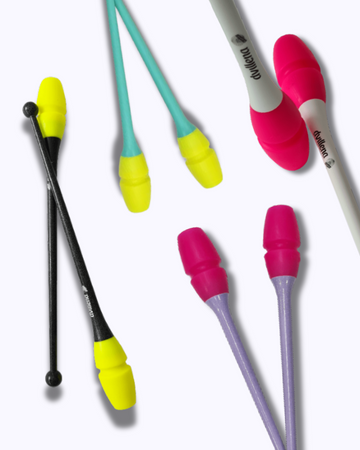
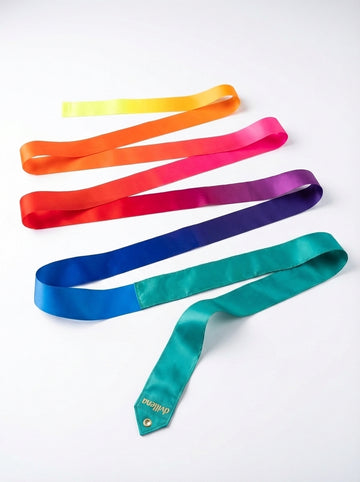
The clearest difference is what the gymnast interacts with. In rhythmic gymnastics, the apparatus is held and manipulated: the gymnast throws, rolls, spins and catches a hoop, ball, pair of clubs or ribbon while performing leaps, balances and pivots. The apparatus must stay in constant motion — a dropped ribbon or club means an immediate deduction.
In artistic gymnastics, the apparatus is the environment. The gymnast vaults over a table, swings on bars, tumbles across a sprung floor or balances on a 10 cm-wide beam. Nothing is carried; the skill lies in what the body does on and around the equipment.
Scoring and Judging
Both sports use the open-ended scoring system of the Fédération Internationale de Gymnastique (FIG), with a Difficulty score (D) added to an Execution score (E). But the panels reward very different things.
In rhythmic gymnastics, under the FIG Code of Points 2025–2028, the D panel counts body difficulties (leaps, balances, rotations), apparatus difficulties and dynamic elements with rotation (risks), while the E panel deducts for both technical faults and artistic faults — musicality, expression and choreography are scored, not optional. In artistic gymnastics, the D score reflects the acrobatic difficulty of the elements and the E panel deducts from 10 for technical imperfections: bent knees, steps on landing, form breaks.
The practical consequence: a rhythmic gymnast can lose points for a routine that ignores the music, while an artistic gymnast is scored on execution and difficulty alone in almost every event.
The Olympic Story
Artistic gymnastics is one of the original Olympic sports, on the program since the first modern Games in Athens 1896; women's artistic events joined in 1928. Rhythmic gymnastics is much younger as an Olympic discipline: the individual all-around debuted at Los Angeles 1984, and the group event followed at Atlanta 1996.
At the Olympics, rhythmic gymnastics remains a women-only discipline. Men's rhythmic gymnastics does exist — Japan and Spain are its best-known homes — but it is not part of the Olympic program. Outside the Games, the sport's biggest stage is the World Championships; the next edition is the 2026 Rhythmic Gymnastics World Championships in Frankfurt in August 2026.
Leotards and Outfits
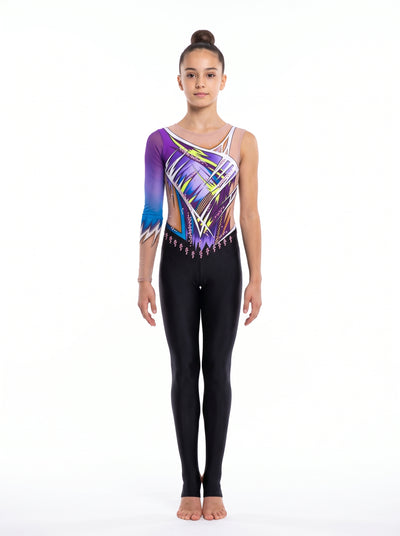
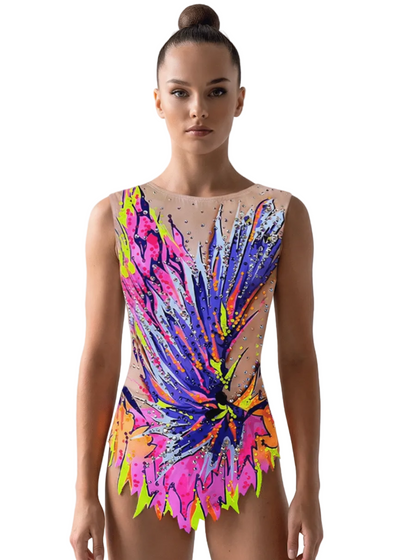
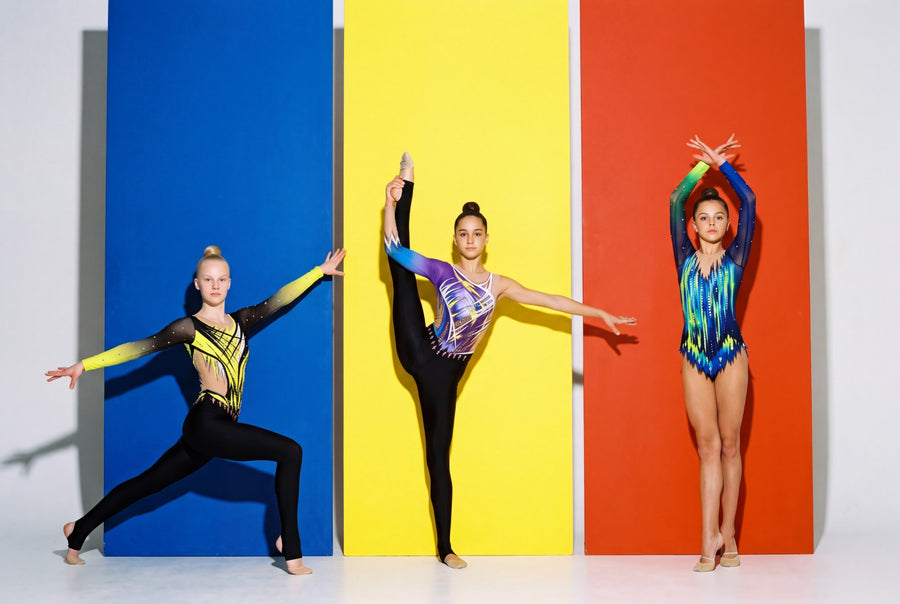
The two disciplines dress differently because they are judged differently. An artistic gymnast wears a streamlined, skirt-less leotard designed for aerodynamic, acrobatic movement. A rhythmic gymnast's leotard may include a skirt and is treated as part of the performance itself: colours, cut and rhinestone work are chosen to match the music and choreography, because presentation is part of the score. That is why competition-level rhythmic gymnastics leotards are designed piece by piece around a routine, the way a costume is designed around a role — the leotard is not a uniform, it is part of the performance.
Which One Is Right for My Daughter?
Both sports welcome children from around age 4–6, and at that age the training looks similar: general coordination, flexibility and basic body shapes. The paths diverge from roughly age 7–8.
- Choose rhythmic gymnastics if she loves music and dance, shows natural flexibility, and enjoys working with objects — throwing, catching, coordinating. Rhythmic develops posture, grace, musicality and fine motor control.
- Choose artistic gymnastics if she is drawn to climbing, jumping and tumbling, and has natural power and fearlessness. Artistic develops strength, spatial awareness and acrobatic skill.
There is no wrong answer — many coaches simply recommend trying a class of each. The child's enthusiasm is a better predictor of long-term success than any physical test.
Frequently Asked Questions
Is rhythmic gymnastics harder than artistic gymnastics?
Neither is objectively harder — they demand different things. Rhythmic gymnastics requires extreme flexibility, apparatus control and the ability to perform precise skills in exact synchrony with music. Artistic gymnastics requires exceptional strength and power and carries higher acrobatic risk. Elite athletes in either sport train comparable hours; the difficulty is simply distributed differently.
Can gymnasts do both rhythmic and artistic gymnastics?
At recreational level, yes — and young children often benefit from sampling both before specialising. At competitive level it is practically impossible to pursue both: the physical profiles diverge (flexibility-dominant vs strength-dominant), and each discipline demands full-time training from around age 8–10. Switching from artistic to rhythmic (or vice versa) at a young age is common; competing in both is not.
Why is rhythmic gymnastics only for women in the Olympics?
The Olympic program simply has no men's rhythmic category — only women's individual and group events. Men's rhythmic gymnastics does exist and is actively practised in countries such as Japan and Spain, each with its own style and competitions, but it has not been added to the Olympic Games.
Do rhythmic and artistic gymnasts wear the same leotards?
No. Artistic leotards are streamlined and skirt-less, built for tumbling and bar work. Rhythmic leotards may include a skirt and typically feature far more elaborate decoration — rhinestones, prints and colour work matched to the routine's music — because artistry is part of the rhythmic score.
How to Choose a Rhythmic Gymnastics Ribbon: Length by Age, Quality and Care