


Choosing a rhythmic gymnastics leotard sounds simple until you're standing in front of a size chart, a wall of fabric options, and a rulebook that has opinions about nude mesh. Whether you're buying for a first-season gymnast or prepping for a major national competition, this guide walks you through every decision — sizing, fabrics, FIG regulations, training versus competition needs, and timing your order so there are no last-minute panics.
Getting the Size Right
Rhythmic gymnastics leotards are worn close to the body — that's both an aesthetic and a functional requirement. A leotard that shifts during a routine is a distraction; one that's too tight will restrict movement and become uncomfortable fast. Neither is acceptable at competition level.
Most brands, including Vinkova, size leotards primarily by height rather than age, because two gymnasts of the same age can differ significantly in build. As a starting point:
- Under 130 cm — youngest beginners; look for size XS or size 1 in most European scales.
- 130–145 cm — pre-competitive juniors; typically size S or size 2.
- 145–160 cm — competitive juniors and younger seniors; size M or size 3.
- 160–170 cm — most senior gymnasts; size L or size 4.
- 170 cm + — taller seniors; size XL or size 5, depending on the brand's scale.
Always check the brand's own size chart against the gymnast's current measurements — chest, waist, and hips — rather than going by age alone. Fabric stretch matters too: a high-content elastane fabric will tolerate a centimeter of difference in a way that a stiffer material will not.
One practical tip: if your gymnast is between sizes, go one size up and check whether the shoulder straps can be adjusted. A leotard that's slightly roomy at the waist is easier to wear than one that pulls at the shoulders during a back walkover.
Understanding the Fabrics
The fabric is where most of the cost difference between leotards lives. Here's what you'll encounter and what each is actually good for.
Lycra (Spandex/Elastane base)
Every rhythmic gymnastics leotard starts with a lycra base — typically a nylon-lycra or polyester-lycra blend. This gives the four-way stretch that allows full range of motion. The quality of that base fabric determines how the leotard moves, how it recovers its shape after washing, and how long it lasts. A higher elastane percentage (18–22%) generally means better recovery and less bagging at the knees and seat over time.
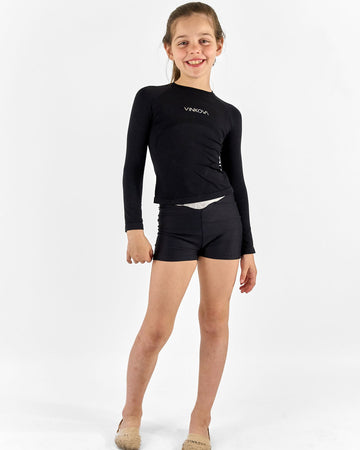
For training, a solid lycra leotard in the club's color is usually all that's needed. It's durable, easy to wash, and significantly cheaper than competition options.
Holographic and Metallic Fabrics
Holographic lycra has a mirror-like, color-shifting surface that catches light dramatically under competition lighting. It's a popular choice for competition leotards because it reads well from the judges' table and photographs beautifully. The trade-off is that holographic fabrics are less forgiving in cut and require more precise construction — a small deviation in seam placement shows.
Metallic fabrics sit between matte lycra and holographic in terms of visual impact. They add shimmer without the full mirror effect, and they're often used for base panels combined with holographic inserts.
Strass and Crystal Decoration
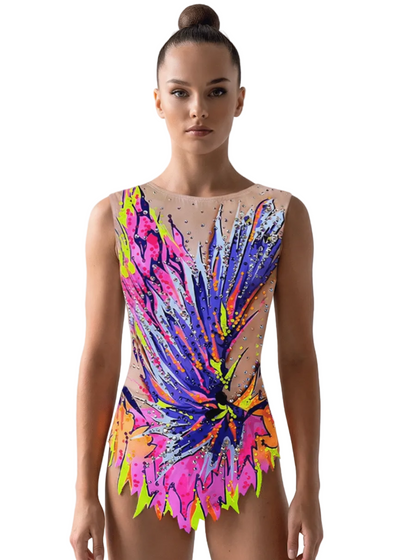
Strass (rhinestone crystals) are the defining feature of high-level competition leotards. Applied by hand or heat-press, they catch light during turns and throws and are part of what makes a competition leotard look finished. The density and placement of strass is a significant driver of cost — a heavily decorated leotard may carry hundreds or thousands of individual stones.
For competition use, ensure the stones are properly set: poorly applied strass can catch on apparatus or fall off during a routine, which is both a safety concern and an Execution deduction risk.
Mesh and Transparency
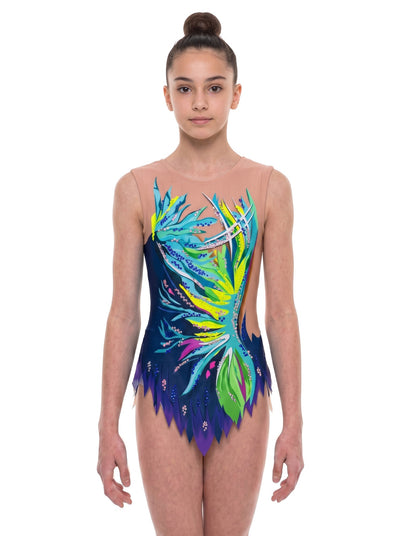
Mesh panels — often called "nude mesh" when they match skin tone — are used to create the illusion of a more open design while keeping the leotard structurally closed. They're popular in competition designs because they allow dramatic cutouts without violating modesty rules. However, this brings us to the most frequently misunderstood area of leotard selection: the FIG transparency rules.
FIG Competition Rules on Transparency and Coverage
Under the current FIG Code of Points (2025–2028 cycle), leotards worn in rhythmic gymnastics competition must cover the body appropriately. Transparent or semi-transparent panels that reveal the body underneath — particularly around the torso and seat — are subject to deductions. The specific rules address:
- The front and back torso must not be transparent in a way that reveals skin.
- Nude mesh panels on the torso are permitted if they are lined — i.e., backed with an opaque layer — so that they do not show through.
- Unlined transparent areas on the body (not just decorative edges or sleeves) can result in an Execution deduction applied by the Superior Jury.
The practical implication: always verify that a competition leotard's torso panels — including any mesh inserts — are fully lined before a gymnast wears it at a FIG-governed or nationally affiliated event. If you're buying online, ask the brand explicitly whether mesh panels on the torso are lined.
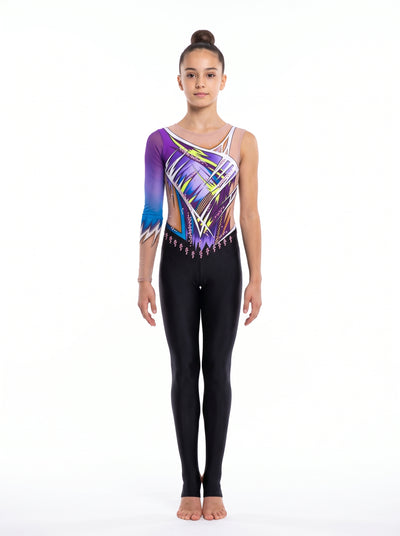
This is one reason Vinkova's 2026 competition leotard collection focuses specifically on opaque construction: no unlined panels, no grey areas at the judging table. It's designed so that coaches don't have to second-guess compliance before a competition.
Training Leotards vs. Competition Leotards
These serve genuinely different purposes, and conflating them costs money.
Training leotards
- Should be durable enough for daily use (multiple sessions per week, machine washing).
- Don't need strass — stones catch on apparatus and wear down over time.
- Club colors are often required; solid matte lycra is the standard choice.
- Budget accordingly: a good training leotard at €50–80 will outlast an expensive one used daily.
Competition leotards
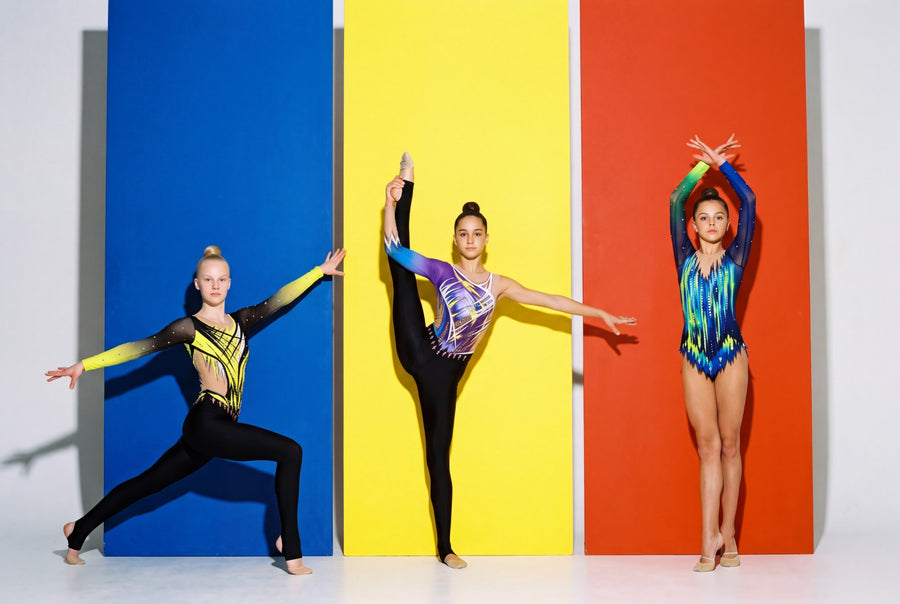
- Designed to be seen at distance under strong lighting — hence holographic fabrics and strass.
- Must comply with FIG or national federation rules on transparency, coverage, and color (the leotard cannot be entirely white or flesh-colored for some events).
- Should be reserved for competitions and dress rehearsals — not worn in training — to preserve the stones and fabric.
- Custom options allow the design to reflect the music and choreography of a specific routine.
A practical approach for most clubs: one or two training leotards per gymnast (rotated to allow washing and drying), and one or two competition leotards per season depending on the competition calendar.
Custom Leotards: When and Why
Custom leotards — where the design, colorway, fabric, and decoration are built specifically for one gymnast or team — are the standard at elite level. For individual gymnasts competing under a personal choreography, a custom leotard that reflects the music and theme of the routine adds a layer of coherence that judges and audiences notice.
Custom work takes time. From briefing the design to delivery, allow a minimum of 4–6 weeks for a custom leotard, and more if you're ordering during a peak period before major championships. For a gymnast competing at a national championship in November, that means starting the conversation in September at the latest.
At Vinkova, custom leotards start from €400 and are designed in-house in Pamplona, Spain. The design process includes fabric selection, decoration planning, and fit verification — which is why the timeline matters.
Care and Washing
Leotards are performance garments and should be treated as such. The rules are consistent across quality brands:
- Hand wash or delicate machine cycle, cold water (30°C maximum). Hot water degrades elastane and causes the fabric to lose its recovery.
- Mild, pH-neutral detergent. Avoid fabric softeners — they coat elastane fibers and reduce stretch performance over time.
- Never tumble dry or hang in direct sunlight for extended periods. Both degrade lycra and can cause holographic fabrics to delaminate.
- For leotards with strass: turn inside out for washing to protect the stones. Check loose stones after each wash and re-secure before the next competition.
- Air dry flat or on a hanger, away from direct heat sources.
When to Order: The Competition Timeline
This is the most consistently underestimated part of leotard planning. The season in rhythmic gymnastics runs roughly from September through June, with national championships concentrated between November and March. That concentration creates demand spikes that affect lead times across the industry.
As a general rule:
- Catalog leotards (standard designs, standard sizes): allow 1–2 weeks for delivery in normal periods; 2–3 weeks during peak season (October–January).
- Custom leotards: allow a minimum of 4–6 weeks from briefing to delivery, and start earlier during peak season.
- For gymnasts competing at international events — including the 2026 World Championships in Frankfurt (12–16 August) — ordering by late June gives comfortable margin for any adjustments.
If you're unsure where to start, the full leotards collection includes both catalog and made-to-order options with current lead times indicated on each product page.
Frequently Asked Questions
What size rhythmic gymnastics leotard should I buy for my daughter?
Size by height first, not age. Measure your daughter's height, chest, waist, and hips, then compare against the brand's specific size chart. If she's between sizes, size up — a leotard that's slightly generous is far more wearable than one that's too tight. For growing gymnasts, it's also worth checking how adjustable the shoulder straps are.
Are nude mesh panels allowed in competition?
It depends on whether they are lined. Under the current FIG Code of Points (2025–2028), nude mesh or transparent panels on the torso are permitted only if they are backed by an opaque lining — so that no skin is visible through the fabric. Unlined transparent areas on the body can lead to an Execution deduction. Always confirm with your brand or supplier that torso mesh panels are fully lined before a competition.
How long does a custom leotard take to make?
Plan for a minimum of 4–6 weeks from the point you finalize the design brief. During peak season — roughly October through January in Europe — lead times can extend, so starting early is always the safer choice. For major competitions like national championships or international events, beginning the process 8–10 weeks out gives comfortable room for fit adjustments and any revisions.
Can the same leotard be used for training and competition?
Technically yes, but it's not recommended. Competition leotards with heavy strass decoration will lose stones during training if they're worn daily, and the fabric will show wear much faster. A better approach is to dedicate 1–2 durable matte lycra leotards to daily training and reserve competition leotards for events and dress rehearsals. It keeps both in better condition for longer.
Rhythmic Gymnastics Apparatus Explained: Hoop, Ball, Clubs, Ribbon and Rope
How to Choose a Rhythmic Gymnastics Ribbon: Length by Age, Quality and Care